
What is a Flumie and how does it work? A beginner's guide

We don’t set out to write the ‘Definitive Guide to Flumies’, but we do aim to provide some basic information if you’re just starting out with these incredible mallets.
KEY TAKEAWAYS
- Flumies produce their characteristic sound through continuous friction against the instrument, generating harmonics that aren’t produced by a conventional mallet.
- They work on practically any type of gong, quartz bowls, some metal bowls, shamanic drums, and other types of tambourines.
- A flumie's behavior changes differently depending on the hardness of the rubber, the head diameter, and the ambient temperature.
- Keeping your flumies clean from dust and dirt is essential to maintain friction and get the most out of them.
WHAT IS A FLUMIE?
Flumies are what we percussionists have for many years referred to as friction mallets or superballs, and we’ve used them on a wide variety of percussion instruments. Nowadays, they have become one of the most interesting and widely used tools for gongs, as well as for certain types of singing bowls.
HOW DO THEY WORK?
Unlike the mallets we’re used to using, which strike the gong, flumies produce their characteristic sound through continuous friction against the instrument, generating harmonics that aren’t produced by a conventional mallet.
The head of the flumie is usually made of rubber, silicone, or synthetic materials with a high coefficient of friction.
By dragging the surface of the flumie across the instrument in a steady motion, harmonics, glissandos and the so-called ‘whale or dolphin songs’ are generated.
Flumies work on practically any type of gong, although their behaviour varies depending on the type of gong and its diameter. They can also be produced on quartz bowls and some metal bowls. They are also generated on shamanic drums and other types of tambourines.

RUBBER HARDNESS
Depending on the hardness of the rubber, the flumie behaves differently.
Hard rubber flumies have a faster attack and greater volume, as well as producing more harmonics than those with soft heads.
Conversely, soft rubber flumies produce a softer sound and warmer harmonics, as well as being easier to control.
SIZE AND DIAMETER
In terms of size, large-diameter flumies produce more bass and a greater number of harmonics simultaneously. Smaller flumies are more precise and therefore make it easier to find specific harmonics.
RUBBER COMPOSITION
The main difference between different flumies lies in the rubber composition. Two mallets that look identical can produce completely different sounds and responses from your gong.
AMBIENT TEMPERATURE
Finally, ambient temperature has a significant influence on how the flumie behaves.
At low temperatures, the rubber hardens, reducing grip and consequently making it more difficult to produce harmonics; conversely, at higher temperatures, the rubber becomes more flexible, improving grip and making it easier to produce harmonics.
HOW DO YOU PLAY A FLUMIE?
We’re going to give you some tips on how to start playing with flumies, although it’s up to you to find out how your flumie works best with your gong.
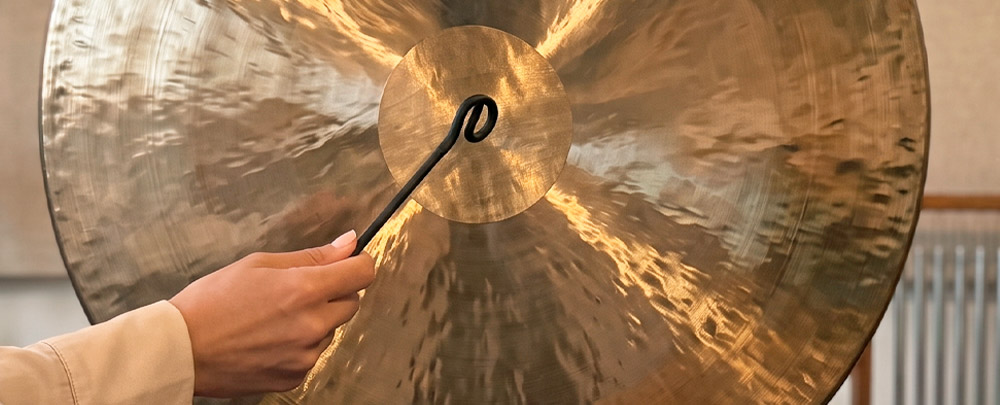
BASIC TIPS
- One of the most common mistakes is to start playing the gong in the centre. You’ll find most of the harmonics between the rim and the halfway point along the gong’s radius. This doesn’t mean you can’t play in the centre, but on many gongs, the centre responds less well to friction.
- Rest the flumie on the gong and start slowly with a slow, continuous movement; you’ll notice harmonics beginning to appear, so you should maintain this speed for as long as you like.
- Maintaining constant pressure is essential because if you apply too much, you’ll find the sound becomes muffled and the mallet doesn’t rub against the gong properly. Conversely, with too little friction, you’ll find that the overtone doesn’t appear.
- Try and experiment by combining speed and pressure. You’ll find that the faster you go, the more volume and treble you’ll get, and with more pressure, you’ll find that more harmonics are generated. Striking a balance between the two will allow you to access an incredible range of possibilities.
ADVANCED TECHNIQUES
Once you’ve got the hang of the flumie, you can try experimenting with these other techniques:
- Moving the flumie from the edge towards the centre creates gradual changes in harmonics.
- Tracing the circumference of the gong produces an enveloping sensation that is widely used and appreciated in sound baths.
- Using a flumie in each hand will allow you to create complex textures.
- Use a mallet and a flumie in each hand. Strike first with a soft mallet and then apply the flumie whilst the gong is already vibrating. This technique is also spectacular for sound sessions.
- Strike with the flumie once the overtone is already active; secondary overtones will appear and the sound becomes more organic
CARING FOR YOUR FLUMIES
We recommend that, when you receive your flumie – and because the head is made of synthetic material – you wash it with warm water and a mild soap to remove any impurities that may be on the head. Then leave it to dry naturally or with a cotton cloth, and never in direct sunlight.
We recommend that you test the flumie on the rim or back of the gong to ensure it does not leave any marks on it.
- After several sessions, it is a good idea to wipe your flumie with a damp cloth and then dry it. Of course, do not use any kind of solvent.
- The flumie is made of synthetic material and excessive heat will damage it, as the rubber may harden or become misshapen.
- Dust and dirt significantly reduce friction, so keeping your flumies clean is essential to get the most out of them.
- When a flumie starts to lose its grip but can still fulfil its function, you can use ultra-fine sandpaper, steel wool or even a used Scotch-Brite-type scouring pad and give it just a few light rubs. In many cases, this will restore the flumie’s effectiveness.
If you follow these tips, your flumie will last longer, your gong won’t get marked, and the experience will be much better.
Bear in mind that, as we said at the start, a flumie works by friction, and this inevitably leads to wear and tear.
Of course, we have an extensive catalogue and stock of all kinds of flumies on our website, which you can view here.
As always, if you need any technical advice or assistance regarding our flumies and percussion instruments, you can contact us at:
- Phone: 954 907 226
- Whatsapp: 672 655 950
- E-mail: info@tamtampercusion.com
- And, of course, at our store in Mairena del Aljarafe, Seville
We hope you found this article interesting.
 |
Jose ManzanaresSymphonic Percussion and Sound Therapy Specialist A classically trained percussionist, professional drummer, and deeply passionate about sound therapy, Jose has been working at TamTam since its inception in 2001. He is the expert who will handle all your inquiries regarding these instruments. If you have any questions about "impossible" spare parts, feel free to write to him. |






 Hall of Fame