


Soul Tuning Fork Harmonic Spectrum Set


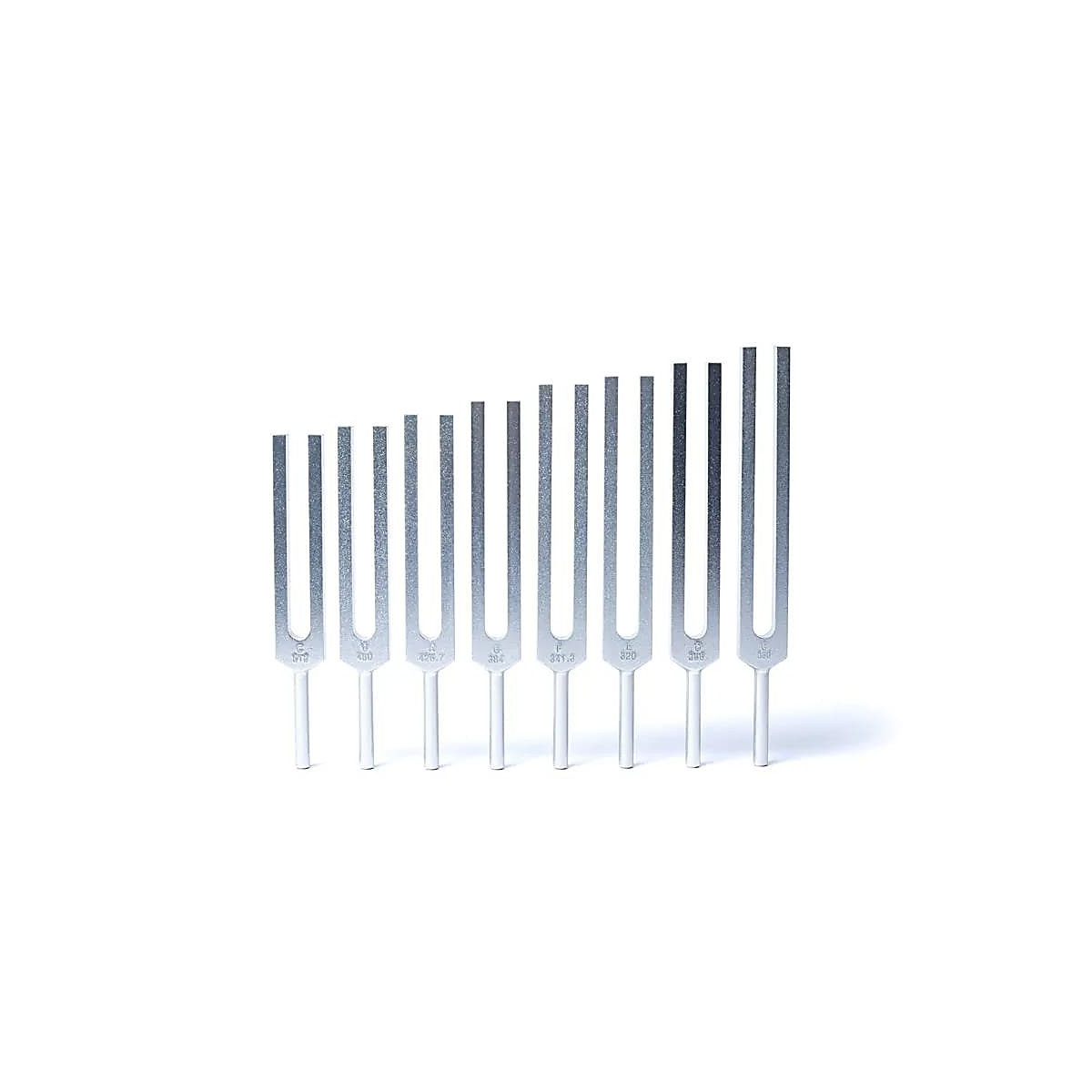
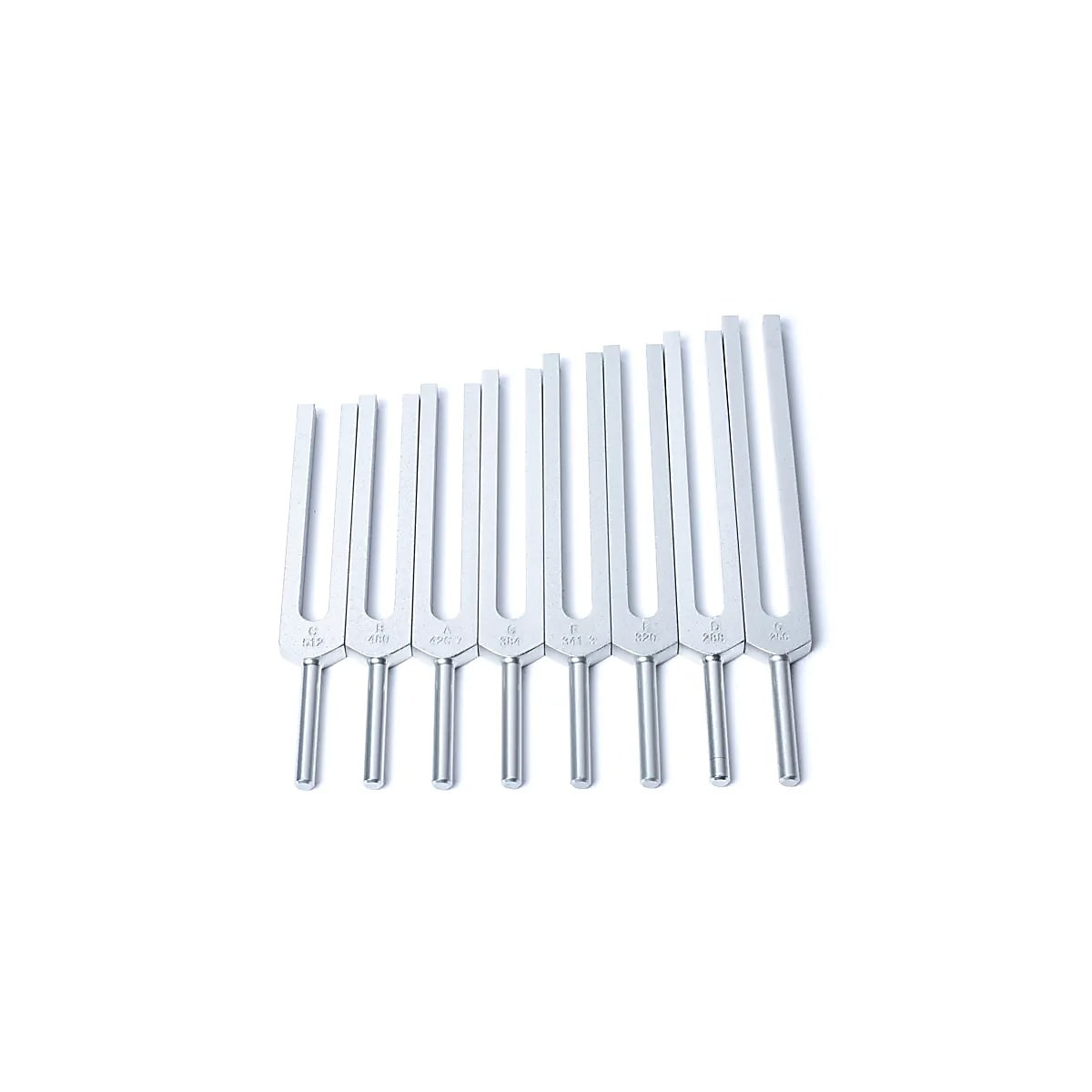
Set of 8 unweighted Harmonic Spectrum tuning forks, designed to work on the physical plane of our body. The physical plane is concentrated, crystallized in a defined, cognitive form, and revolves around the 5 human senses and various parts of our physical body such as tissues, fluids, bones, organs, etc.
This set produces pure sounds and overtones, whose effect is to help relax the body and focus on oneself.
Different musical intervals can be produced by sounding two tuning forks simultaneously. Each musical interval creates a unique relationship between the physical and subtle energy bodies, the chakras.
- Length of the tuning forks: 17 to 21 cm
- Weight: 550 g
- Made of aluminum
- Calibrated with a deviation margin of ±0.25%.
- Includes a blue velvet bag
The 8 harmonic tuning forks in this set are based on:
- Root chakra - Red - C - 256 Hz
- Sacral chakra - Orange - D - 288 Hz
- Solar plexus chakra - Yellow - E - 320 Hz
- Heart chakra - Green - F - 341.3 Hz
- Throat chakra - Blue - G - 384 Hz
- Third eye chakra - Indigo - A - 426.7 Hz
- Crown chakra - Violet - B - 480 Hz
- Higher octave of the root chakra - Red - C - 512 Hz
Chakras
Chakras are subtle energy points, literally called wheels of energy. They function as places of energy exchange. In fact, we have hundreds of chakra points spread throughout our subtle energy system. However, the most well-known are the seven main chakras, which are connected in the central energy channel of our body, running along the spine. When the chakras function properly, these centers are gateways for the vital energy that enters our body through channels (nadis) and meridians throughout our subtle body. At the same time, they are also escape points for low-frequency energy to flow back to the transforming subtle bodies. Each of the seven main chakras represents a level of consciousness or stage of life development, viewed from the perspective of our physical existence. Chakras can function poorly when they remain in a negative state for long periods due to negative habits and accumulated emotions. This makes it difficult for the personality to fully integrate the level of consciousness that each chakra represents. When the chakras are open and balanced, they form an integrated system in which each chakra depends on the others to function optimally.
Differences between weighted and non-weighted tuning forks.
Weighted
- These tuning forks work more on the physical plane.
- You can feel the vibration stronger and at a deeper level when the tube is placed on the body.
- Their sound lasts longer, but is softer and more diffuse.
- They are heavier.
- They are shorter in length than non-weighted forks.
- They are excellent for pain relief, reducing the inflammation and inducing the relaxation.
- They are typically placed on the body or near the ears.
- To sound them, you can simply strike them on the palm of the hand or use a tuning fork activator.
- The weighted tuning fork has a round weight at the end of each tube.
Non-weighted
- They act at a more subtle level, in a delicate or mysterious way.
- They move with less physical movement. The sensation of the vibration is subtler when the tube is on the body.
- The sound does not last as long, but is sharper and more crystal-clear.
- They are lighter.
- They are longer than weighted tuning forks.
- They are excellent for mental and emotional balance, improving the energy field, enhancing the physical health, and promoting spiritual growth, helping to create inner harmony and fulfillment.
- These tuning forks are placed around the body and near the ears.
- To sound them, you can simply strike two tuning forks together or use a tuning fork activator.
- Their ends are straight.
EAN13:






 Hall of Fame